Managing soil nitrogen, moisture and plant production interactions for increased grain production potential under climatically variable conditions
2023-4 Yuna Farm Improvement Group
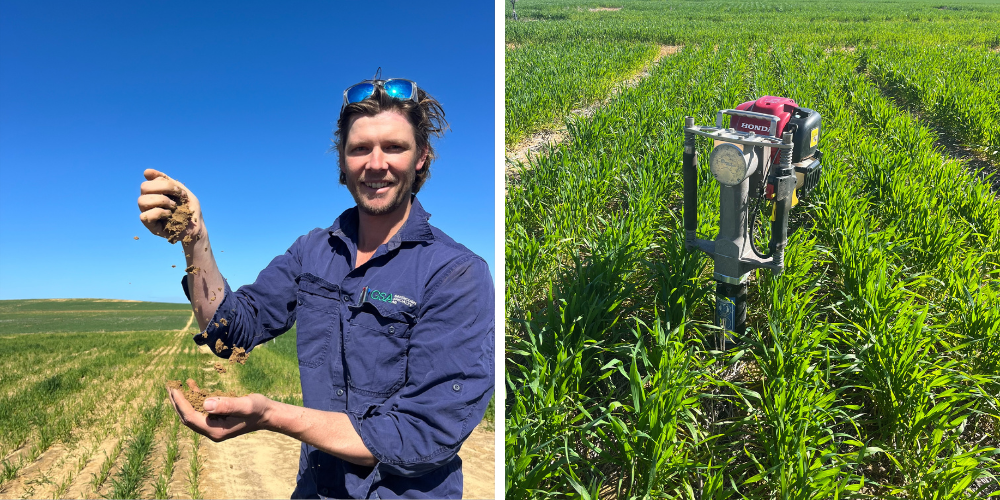
Overall Objective
To establish a stronger understanding for soil nitrogen supply over a legume/wheat/wheat rotation, across the same site in 2023 and 2024 to see how this supply is affected by given seasonal conditions.
This nitrogen supply curve will be established and related to measurable parameters including plant production (kg(DM)/ha/day, t(DM)/ha), plant consumption of nitrogen (kgN/ha/day), grain production (t/ha), water use (mm/day) and tolerance to environmental stressors (T, drought, disease). A better understanding will benefit industry to minimise excessive nitrogen expenses and losses, improve profitability and yield outcomes as well as reduced environmental impacts whilst maintaining or improving soil fertility. A key aim is to determine total crop N capture, total soil N supply and total N loss (unaccounted for) over the course of two years of wheat/wheat plantings.
Project Synopsis
Nitrogen management remains one of the enigmas of crop management throughout dryland broadacre agriculture within Western Australia. Throughout the last 100 years of research into management practice, findings suggest we rely on 30-40% Nitrogen Use Efficiency (NUE) as industry standard best practice.
Through investigating the impact planting density can have on nitrogen leaching losses, the outcomes of this project were as a result of three nitrogen application rates (0N,25N, 80N) across two sowing densities (75kg/ha wheat, 150kg/ha wheat), for two seasons (2023,2024).
The site was sown on a 2022 vetch brown manure and a single treatment was irrigated pre-seeding (40mm, March) both seasons, to ensure deep soil moisture at sowing to encourage leaching conditions after dry summers.
Results of the site indicate the following:
- Increasing seeding rate (kg/ha or plants/m2) increases early season plant accumulated nitrogen.
- Significant early season rainfall can create extremely high leaching events even in deep, strong sandy soils where subsoil constraints have been ameliorated.
- In 2023 droughted conditions, early season re-distribution of nitrogen reduced crop dry matter.
- In 2024 decile 10 rainfall year, early season leaching reduced overall dry matter production.
- Across both a droughted and a wet season, early season dry matter production from increased plant densities increased realised yield and grain quality.
- Across both 2023 and 2024 seasons, early season biomass resulted in increased NUE to 98% and 202% respectively.
- Across both seasons, early season rainfall increased soil mineralised N but reduced NUE from increased in-season leaching.
- High Density Sowing (HDS) yielded similar to 80N Low Density Sowing (LDS) at 25N, but more than 25N LDS. 80N yielded no more than 25N under HDS. 80N yielded more than 25N under LDS.
Project Status: Complete
Report: Available
Project Funding
Council of Grain Grower Organisations Ltd. funding budgeted for the project on award.
Lead Researcher
Nick Eyres
Lead Researcher Email
[email protected]