Control of cockchafers
2025-3 ConsultAg
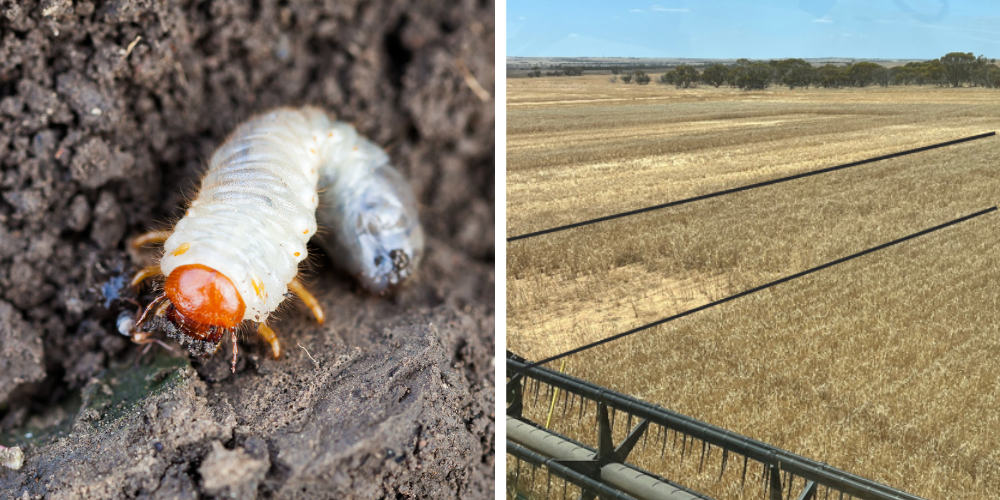
Overall Objective
The aim of this project is to provide cockchafer management options to growers. Growers, with the impending loss of chlorpyrifos, are unsure of what registered management options are effective for cockchafers as crop loss is the first sign of cockchafer activity.
Project Synopsis
Cockchafer damage has become an increasing concern for grain growers across parts of Western Australia, particularly with the loss of long-relied-upon insecticides such as chlorpyrifos. This COGGO-funded project was designed to give growers confidence and clarity by identifying practical, effective and registered management options to reduce crop losses caused by cockchafers.
During the 2025 growing season, three farmer-scale trials were conducted in cockchafer-prone paddocks in the Lakes district. These trials evaluated seed-applied and in-furrow insecticides, different product placement methods, and the role of seeding rate in mitigating damage. The work was carried out under real farming conditions to ensure results were directly relevant to growers.
The project demonstrated that imidacloprid seed treatments were the most consistent and reliable option for reducing cockchafer damage, delivering yield improvements of around 10–12 per cent under moderate to high pest pressure. Seed-applied treatments proved more effective than insecticides placed with fertiliser below the seed, highlighting the importance of protecting young plants during early establishment when cockchafer feeding causes the greatest impact.
The trials also showed that agronomic decisions matter. Higher seeding rates significantly improved early crop establishment, canopy development and crop uniformity, helping buffer yield loss even where insecticide performance was variable. Best results were achieved using an integrated approach, combining effective seed treatments with sound agronomy.
An economic assessment indicated a strong return on investment for affected paddocks, with close to a 7:1 return when imidacloprid seed treatment was combined with a modest increase in seeding rate. Beyond yield gain, growers also benefit from more even crops and improved weed competition, adding longer-term rotational value.
Project outcomes have been widely communicated. Results were featured in an ABC News article and on ABC television, discussed at local field walks, and presented at multiple pre-seeding grower seminars across the region. This strong extension program ensured rapid awareness and adoption of findings.
Overall, the project has provided growers with clear, evidence-based guidance on managing cockchafers using currently registered tools, helping de-risk decision making in the post-chlorpyrifos environment and supporting more resilient grain production systems in Western Australia.
Project Status: Complete
Report: Unavailable
Project Funding
Council of Grain Grower Organisations Ltd. funding budgeted for the project on award.
Lead Researcher
Ben Whisson
Lead Researcher Email
[email protected]
Report Unavailable
The Final Report is not available for this project.
Please contact the lead researcher for more.
Lead Researcher
Ben Whisson: [email protected]