Investigating systems for control of Desiantha weevil in relation to resistance and biology in WA
2023-3 Department of Primary Industries and Regional Development
Overall Objective
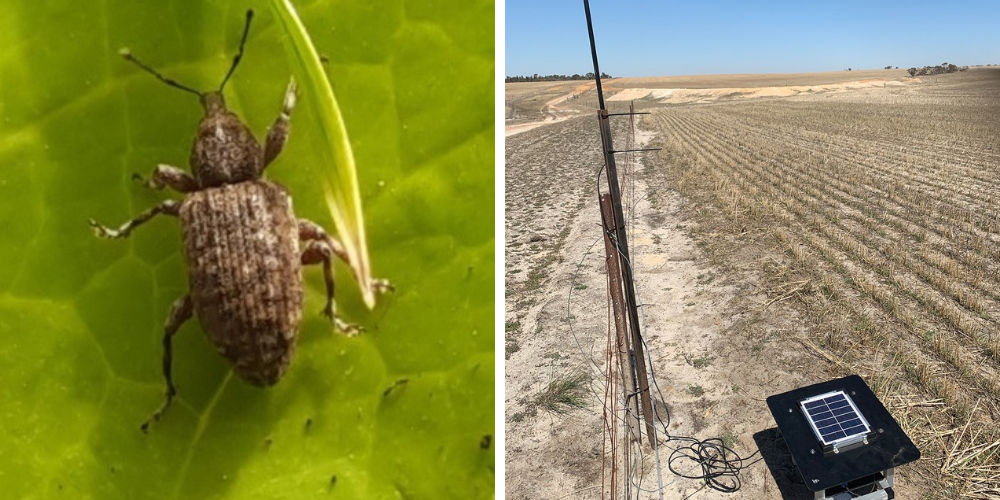
The aim of this study is to determine if desiantha weevil are resistant to current insecticides and to investigate their biology (host plants and environmental cues) to identify improved management options.
Project Synopsis
Desiantha weevil is a significant pest of canola in Western Australia, contributing to substantial economic losses estimated at approximately $1.8 million annually for growers. Control of this pest has relied heavily on synthetic pyrethroid (SP) insecticides, particularly alpha-cypermethrin. However, unconfirmed reports of spray failures between 2019 and 2022 raised concerns that desiantha weevil populations may have developed resistance to these chemicals.
Current management practices depend largely on SP applications prior to and at canola germination. As a standalone strategy, this approach is unlikely to be sustainable. Therefore, an improved understanding of environmental cues and host plant use is critical for developing more effective and sustainable management strategies. At present, host plant associations of desiantha weevil are poorly understood in Western Australia. While larvae are documented to primarily feed on grasses, anecdotal evidence suggests they may also utilise canola as a host. Improved management will require a better understanding of the environmental and agronomic factors influencing desiantha weevil populations.
The aim of this study was to determine whether desiantha weevil has developed resistance to current insecticides and to investigate its biology, including host plant use and environmental drivers, in order to identify improved management strategies.
To assess resistance, bioassays were conducted on desiantha weevil populations collected from multiple locations across the Albany and Esperance regions. These tests consistently showed that all weevils died when exposed to alpha-cypermethrin, even at concentrations lower than those typically applied in the field. Field surveys of sprayed paddocks also found no surviving weevils. Together, these results indicate that alpha-cypermethrin remains effective and that resistance is not currently evident in these populations.
Research into the biology of desiantha weevil provided important insights into host plant preferences and lifecycle. Trials demonstrated that the weevil has a broad host range, with a clear preference for certain weed and cereal species. Capeweed and sorrel were identified as the most favourable hosts, followed by wheat, oats, cudweed, vetch, and barley. In contrast, canola did not support completion of the weevil’s lifecycle under laboratory conditions. Despite this, larvae have been observed in canola paddocks in the field, suggesting that the weevil may partially develop on non-preferred hosts or rely on alternative hosts at different life stages.
The study also examined environmental factors influencing weevil activity. Monitoring using automated pitfall traps showed that adult weevils are most active in autumn between late afternoon and early morning, particularly from 5:00 pm to 1:00 am. This pattern supports current recommendations for late-afternoon insecticide applications.
Seasonal observations revealed that weevil populations are highly visible and abundant in spring but become difficult to detect during late summer, when adults tend to shelter under stubble, rocks, and other debris. Whereas in autumn, desiantha weevils were readily found when their preferred weed hosts, particularly capeweed had germinated.
Overall, these findings indicate that while insecticides remain effective, long-term management of desiantha weevil will require a more integrated approach. Growers are encouraged to adopt integrated pest management (IPM) strategies, including controlling key weed hosts within paddocks and between growing seasons, monitoring paddocks for weevil presence in spring, and using higher seeding rates to minimise crop damage. These strategies will help reduce reliance on insecticides and improve the sustainability of desiantha weevil management in Western Australian cropping systems.
Project Status: Complete
Report: Available
Project Funding
Council of Grain Grower Organisations Ltd. funding budgeted for the project on award.
Lead Researcher
Svetlana Micic
Lead Researcher Email
[email protected]