Identify and combine the best alleles from two genes to achieve maximum pod-shattering resistance in narrow-leafed lupin
2022-2 Murdoch University
Overall Objective
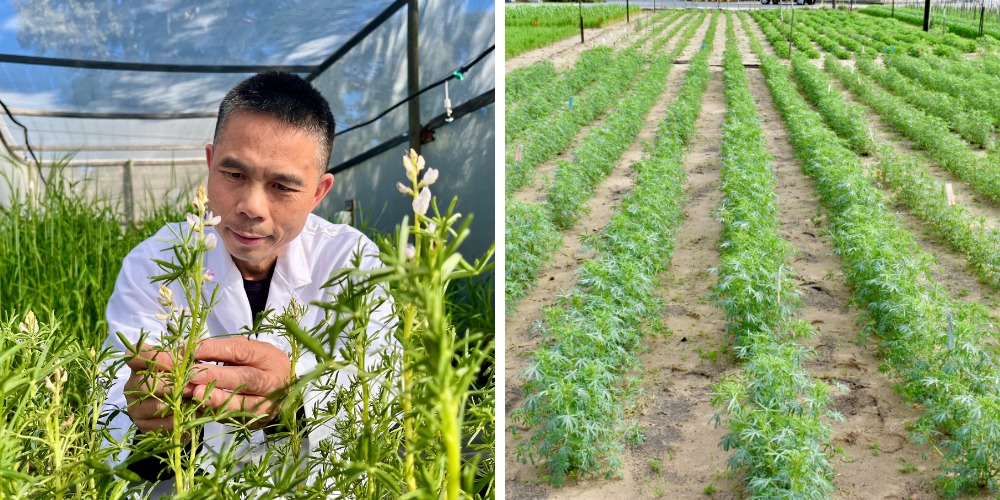
Western Australia is currently responsible for about 80% of world lupin production. Pod-shattering (pod splitting) before and during harvest has been identified as one of the significant factors contributing to yield loss of narrow-leafed lupin (NLL) in WA.
This project aims to screen and combine the best pod-shattering resistant alleles to achieve maximum resistance to pod-shattering in NLL. We will first use our NLL mapping populations to pinpoint genes underlying the two pod-shattering resistance genes (tardus and lentus) through fine-mapping.
We will further screen the alleles of these two genes from our current lupin breeding germplasms with reduced pod-shattering for alleles achieving the optimal resistance to pod-shattering.
We will finally pyramid the best tardus and lentus alleles into one accession by crossing to achieve maximum resistance to pod shattering.
The outcome from our project will lead to creating superior NLL varieties with minimal yield loss due to pod shattering under WA’s arid and semi-arid farming environments.
Project Synopsis
In this project, we selected 14 top lines from the 203 NLL diversity accessions that exhibited non-pod shattering (0-5%) across three environments in Western Australia: South Perth, Manjimup, and Mullewa, over two years.
This germplasm provides genetic resources for breeding programs. Two significant QTL/genes (tardus and lentus) that control pod-shattering were identified, and molecular markers were developed to evaluate pod-shattering based on the fingerprints of these two loci.
The pod-shattering scoring method involved both visual scoring in the field and calculating the pod-shattering ratio after harvest. We devised an improved method for calculating the pod-shattering ratio using oven treatment at 50 °C for four days. This scoring method can more effectively distinguish lines with reduced pod-shattering.
One accession carries the pod-shattering allele at the lentus locus; however, its pod-shattering rate was only 5% in our trials. This indicates that this line possesses a new, less pod-shattering gene. We crossed this line with two elite lines, and the offspring exhibited less pod-shattering than their parental lines. The F2 and F3 seeds, which combine the new genes with the two known loci (tardus and lentus), were generated for breeding programs. The progenies combined the best pod-shattering resistant alleles and achieved maximum resistance to pod-shattering in narrow-leafed lupin.
The outputs of this project will lead to the development of new lupin varieties, which will greatly benefit Western Australian lupin growers.
Project Status: Complete
Report: Unavailable
Lead Researcher
Tianhua He
Report Unavailable
The Final Report is not available for this project.